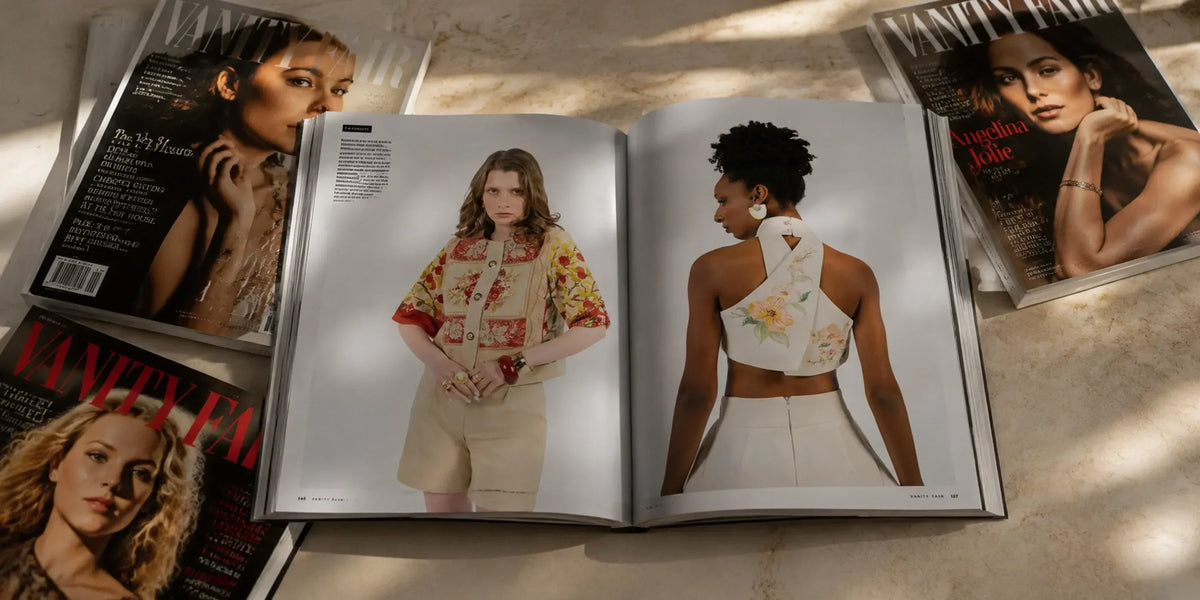
Why Luxury Brands Value Being Featured in Vogue
There is a kind of beauty that only becomes visible once it is seen by someone else. A dress can hang finished and flawless in a quiet studio for months, and until it is looked at by the right eyes, it remains, in some sense, unfinished. Water behaves the same way. Left alone, it simply fills whatever shape contains it, without ambition. It is only when it moves, when it is disturbed into a current, that it finds a direction and becomes something closer to a force. Luxury fashion works on a similar principle.
Craft alone does not make a house significant. What moves a name from workshop to legend is the moment someone with the authority to be believed decides to look, and to say so publicly. For more than a hundred years, that authority has, more often than any other name, belonged to Vogue.
Vogue’s Position as the World’s Leading Fashion Authority
The magazine did not begin as an oracle. In 1892, Arthur Baldwin Turnure launched it as a modest weekly account of New York society, closer to gossip than to prophecy. It was Condé Nast’s purchase in 1909 that changed its chemistry entirely, turning a society paper into an instrument for shaping how people saw themselves. Under Diana Vreeland, the magazine learned to dream in colour rather than simply describe it; under Anna Wintour, since 1988, it learned to move at the speed of the industry it covers.
What survives across all of that change is a single instinct: to notice things before the rest of the world agrees they are worth noticing. This is why a Vogue feature reads differently to those inside the industry than it does to those outside it. To the public, it looks like publicity. To the industry, it looks like a verdict.
Why Luxury Brands Seek Editorial Features in Vogue
When a house appears in Vogue’s pages, the endorsement arrives filtered through independent judgment, which is what allows it to function as proof rather than persuasion. For an established house, it confirms a position already held. For one still finding its footing internationally, it can be the single moment that widens the room it is allowed to stand in. Fashion professionals read the same pages as the public, so a feature moves credibility and desire at once, through two audiences that rarely respond to the same signal.
Storytelling and Creative Identity in Luxury Fashion
None of this would matter if fashion were only fabric. What gives a garment its pull is the story folded into its seams: the hand that shaped it, the discipline behind its construction, the heritage it carries forward or the risk it takes in departing from it. Colour tells this story better than almost anything else.
Pigment does not sit obediently where it is placed; it bleeds, it drifts, it finds its own edges the way water finds the lowest point in a room, and a garment that lets it do so honestly says more about the maker’s intention than any label ever could. Vogue’s editorial instinct has always leaned toward this deeper layer, choosing to linger on process rather than settle for product, because process is where beauty first shows a sign of itself, before it becomes finished enough to be sold.
Why Vogue Recognition Matters for Independent Luxury Brands
For an independent house, this attention carries a different weight entirely. Established names arrive with infrastructure already built around them; smaller ones arrive with only the work itself. A feature does not manufacture originality that was not already there, but it does what strong light does to a room already furnished with care: it does not change the shape of anything; it simply lets it be seen. For brands built on limited runs and handwork, where each object is closer to a singular gesture than a repeated product, this kind of visibility often matters more than volume ever could.
Rondooz Featured in Vogue
Rondooz’s recent feature in Vogue sits inside this same current. The house works less like a factory and more like a small atelier of wearable art, where garments are shaped through hand painting, embroidery, and textile craftsmanship built patiently around individual pieces rather than repeated ones.
Colour is allowed to move across fabric the way it moves across water, unwilling to be pinned into a fixed pattern, and each finished piece carries the particular trace of the hand that made it. That Vogue chose to look closely at this work is not, in the end, a departure from anything discussed here. It is simply the same current finding, once again, a shape worth being seen.