Embellished Clothing Where Every Detail Tells a Story
Clothing can do more than cover the body or follow a silhouette. Embellished clothing brings together material, technique and meaning through embroidery, beads, crystals, painting and carefully placed details. These elements can express identity, preserve cultural memory and change how a garment catches light. At its most considered, embellishment shapes the design itself. Rondooz explores this idea through wearable art, combining recovered needlework, original painting and hand-applied ornament.
What Is Embellished Clothing?
Embellished clothing uses decorative materials or techniques beyond the structure of its base fabric. These include embroidery, beads, sequins, crystals, appliqué, metallic threads and hand-painted motifs. Some add colour and pattern; others introduce relief, weight, movement or reflection.
The appearance of embellished clothing depends partly on how its decorative elements are created. Embroidery adds stitches to the fabric, while appliqué attaches separate pieces of material and beadwork introduces texture one bead at a time. Hand painting, by contrast, allows an artist to work directly on the surface. A printed floral pattern is usually part of the textile's original design, whereas sewn-on beads add a separate layer of material and handwork. These distinctions are not always clear-cut, as several techniques can contribute to a single garment.
Why Are Clothes Embellished?
Clothing decoration can serve practical, social, cultural and personal purposes. It may distinguish ceremonial dress from everyday wear, communicate status or belonging, or mark important events. Motifs can carry religious, regional or family associations; elsewhere, they express individual taste and artistic identity.
Embellishments also influence how a garment looks and moves. Raised stitching casts shadows, crystals catch the light, and beads can alter the way fabric hangs. A few details around the collar may be enough to draw the eye, while a denser arrangement can become the main feature. The placement of each element matters, too: careful spacing and a considered balance of colour, scale and texture help the details work together rather than compete for attention. Durability is another consideration, particularly when different materials are combined.
Explore Limited Edition
Loading the collection...
How Is Embellished Clothing Made?
Embroidery and needlework
Embroidery uses needle and thread to create lines, motifs or pictorial scenes. The Victoria and Albert Museum documents the technique across centuries, cultures and uses, from household textiles to elaborate garments. Explore the V&A’s embroidery collection.
Needlepoint, or canvaswork, builds images through stitches worked on a regular canvas ground. Cross-stitch forms motifs through intersecting diagonal stitches.
Beads, sequins and crystals
Beads and sequins create texture, colour and reflected light. Small beads can trace a contour; larger stones establish focal points. Metallic bugle beads create directional lines, while faceted crystals flash as the wearer moves.
Applique, patchwork and recovered textiles
Appliqué involves sewing or attaching a piece of fabric onto another, whereas patchwork brings smaller pieces together to form a larger design. Working with existing needlework calls for a little more care. The textile needs to be checked and stabilised before it can be incorporated into a new garment, with particular attention to preserving the original image and the details that give it character.
Hand painting and mixed media
Painting on fabric gives designers another way to express an idea through colour and form. It may sit alongside embroidery, for example, or allow a motif to flow from one part of a garment to another. Some pieces bring several techniques together, combining painted details with beads, crystals, metallic elements or stitching. When these materials are chosen with care, their colours, shapes and textures work together to create a cohesive design.

A Brief History of Embellished Clothing
Embellished clothing has evolved differently across cultures and periods. The materials people used, along with trade, ceremonial customs and changing tastes, all influenced the way textiles were decorated. Embroidery, for example, found a place in religious settings, royal households and everyday domestic life, appearing on garments as well as household furnishings.
The Metropolitan Museum of Art’s research on European textiles from 1600 to 1800 describes embroidery using silk, metal threads and seed pearls, alongside canvas needlework for furnishings and wall hangings. These examples show the range from pictorial decoration to repeated geometric patterns.
Textile techniques and motifs travelled across borders through trade and migration, often taking on new forms as local craftspeople adapted them to their own materials and traditions. Tracing the history of an individual textile, however, requires more than visual comparison. A pattern may resemble work from a particular period or region, but this alone cannot establish when it was made, who created it or who first owned it. Such details need supporting evidence.
Craft-led movements also challenged divisions between fine art, design and dress. The V&A traces embroidery and handmade production within the Arts and Crafts movement around the turn of the twentieth century. Today, designers revisit these techniques through new materials and silhouettes.
Embellished Clothing Through the Artistic Vision of Rondooz
Rondooz treats clothing as wearable art: a meeting point between textile history, handwork and original artistic direction. The three pieces below demonstrate different approaches. Each uses embellishment for a specific purpose, rather than applying decoration uniformly across the surface.
Pastoria Ensemble — A Landscape Reimagined
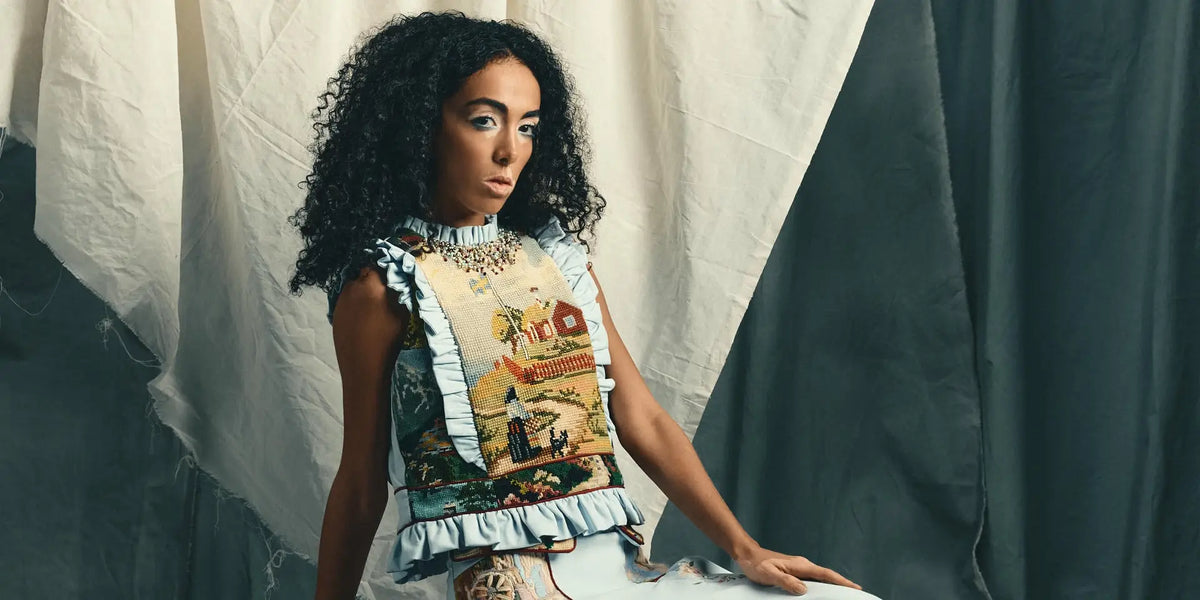
Pastoria combines pale-blue lightweight denim with several vintage needlepoint and embroidered fragments sourced in Finland. The central pastoral panel depicts a woman, a cat, cultivated fields, a red rural building and a distant windmill. The seller attributed the principal panel to 1988, although the textile itself carries no visible date, signature or maker’s label. Its exact place of manufacture and ownership history remain unknown.

Rondooz did not create the original stitched scenes. The atelier selected, cleaned, stabilised and recomposed separate fragments into a new garment. The result is not a restored, intact tapestry but a new composition built from distinct textile histories. Hand-painted roses, buds and trailing foliage add an original layer to the denim, while burgundy piping links the red details across the design.
The collar brings a different kind of embellishment. Varied stones, including natural stones, form a dense arrangement at the centre and disperse towards the shoulders. Their polished and faceted surfaces contrast with the matte wool stitches. This placement creates a focal point near the face without making every part of the ensemble equally bright. Pastoria shows how embellished clothing can balance inherited needlework, new painting and reflective materials.
Narrative Panel Gobelin Blazer — Art in Layers
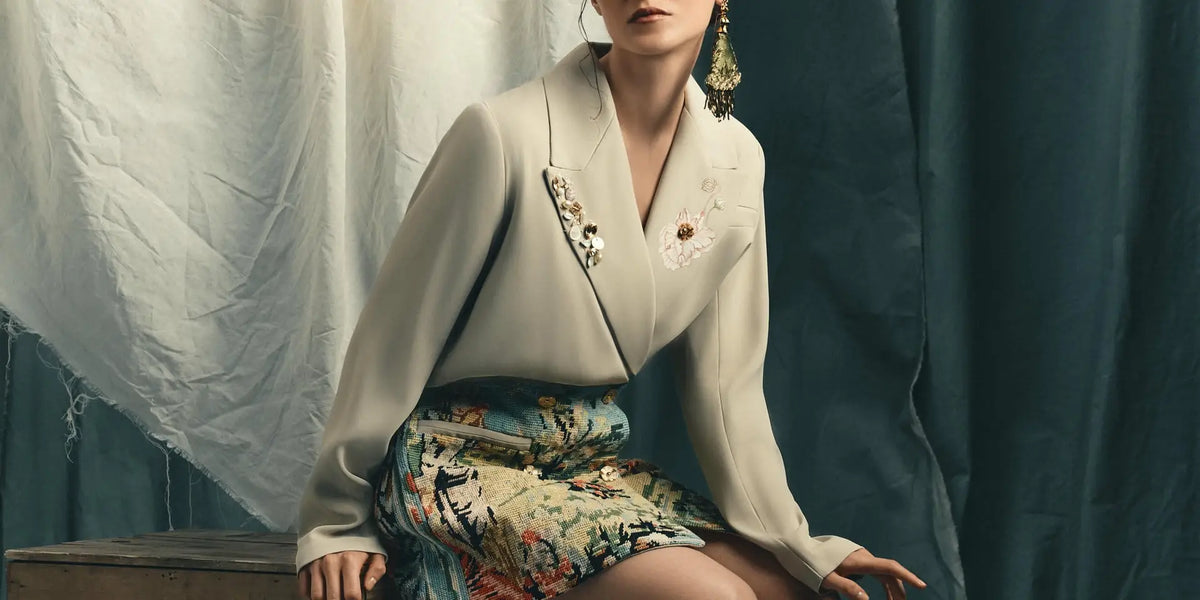
This One of One blazer combines a single continuous piece of recovered pictorial needlepoint sourced at a traditional market in New York’s Chinatown with black crepe, sculptural botanical jewel embroidery and an original hand-painted composition on the back. The needlepoint has no visible date, maker’s mark or documented ownership history, so its maker and precise age remain unknown.
The atelier assessed, gently cleaned, stabilised and reinforced the textile before integrating it into the jacket. Its stitched landscape and architectural details move from the front towards the shoulder and back. Black crepe frames the dense image and leaves areas of visual rest. The textile is therefore part of the garment’s composition, not simply a patch attached to a finished jacket.
The front features a raised botanical design of beads, crystals and pearl-like details. Silver and gold bugle beads follow the stems and spirals, while darker beads define the petals. Faceted stones catch the light, contrasting with the matte surface of the densely stitched needlepoint. On the back, a Japanese-inspired garden introduces a quieter mood. The hand-painted scene is an original Rondooz composition, not a reproduction of a known artwork. The front retains a fragment of the textile’s unknown past, while the back tells a new story through colour and carefully considered empty space.
Nordic Gobelin Jacket — A Woven Welcome
Nordic Gobelin combines dark denim with two recovered Nordic hand-worked textiles sourced at a traditional market in Copenhagen. The cream panel appears to be a Danish Klokkestreng, a narrow decorative wall hanging worked in counted cross-stitch. It carries a Danish verse inviting guests from the south and north, on ordinary days and festive occasions. Comparable examples suggest a possible date between the 1960s and late 1970s, most plausibly the 1970s. This remains a comparative estimate, not a confirmed date for the Rondooz textile.

A separate, denser fragment in burgundy, cream and green frames the collar and sleeve edges. Its geometric stars, lozenges and stepped motifs contrast with the words and small images at the centre. The two textiles retain their different roles: one communicates a welcome, while the other creates structure around it.
The back features original Rondooz hand painting informed by Nordic decorative folk art. Its curving stems and stylised flowers echo the stitched motifs on the front. The painting should not be described as authentic Rosemaling, although it shares a broad affinity with Norwegian decorative painting. Hand-applied crystals, blue pearl-like beads, seed beads and metallic gold elements complete the design. The pocket flaps carry the densest ornament, turning functional details into focal points. On the back, the embellishment remains more restrained, marking flower centres and stems without obscuring the painting.
Nordic Gobelin demonstrates how embellished clothing can carry a message while combining textile recovery, painting and hand-applied detail. Its appeal lies in the relationship between the welcome verse, the two distinct needlework traditions and the new composition that brings them together.
What Makes an Embellished Piece Meaningful to a Collector?
Collectors often look beyond rarity when choosing a piece. Its concept, the quality of the craftsmanship, the materials used and the way the different elements come together can all matter. Provenance is important, too, but it needs to be supported by evidence. If the maker or date is unknown, it is better to leave those details open than to fill the gaps with an unverified story.
The three Rondooz pieces illustrate how these qualities can take different forms. Pastoria builds a new composition from separate needlework fragments, Narrative Panel Gobelin contrasts recovered pictorial textiles with raised embellishment and original painting, and Nordic Gobelin brings a traditional welcome message into a new artistic context. In each case, the relationship between the existing textile and the new design is central to the piece's character.

A Capsule can bring several pieces together around a common artistic idea. A One of One piece is unique and will not be reproduced in exactly the same form, whereas a limited edition is produced in a defined number. Neither designation guarantees that a piece will gain financial value over time. A more considered assessment looks at what can be documented about the work, the quality of its craftsmanship, the way its elements come together and its place within the broader practice of Fashion as Art.
Embellishment as an Artistic Decision
Embellishment becomes meaningful when every element contributes to the garment as a whole. Through the careful combination of recovered needlework, original painting and hand-applied details, Rondooz gives existing textiles a new context while preserving the character of their craftsmanship. This approach places embellishment at the heart of wearable art, where material, artistic intention and cultural memory come together.
Frequently Asked Questions
What Makes Embellished Clothing a Work of Art?
Why Is Vintage a More Appropriate Term Than Antique for Older Gobelin Textiles?
Should Vintage Needlepoint Be Described as Gobelin Tapestry?

Written by Marzieh Alemi